

Over the past twenty years, we've watched organisations in semiconductor manufacturing,advanced engineering and high-tech sectors invest heavily in automation. New control systems, new manufacturing equipment, new data platforms—each one solving specific problems, each one effective in isolation.
Then something predictable happens: these systems accumulate. They co-exist but don't integrate. Information flows into one system and gets trapped there. Engineers manually copy data between tools. Critical operational decisions depend on reports that are hours out of date. Nobody's made a mistake; the organisation has simply reached the point where growth has outpaced the ability to keep systems connected.
This is the middleware problem.
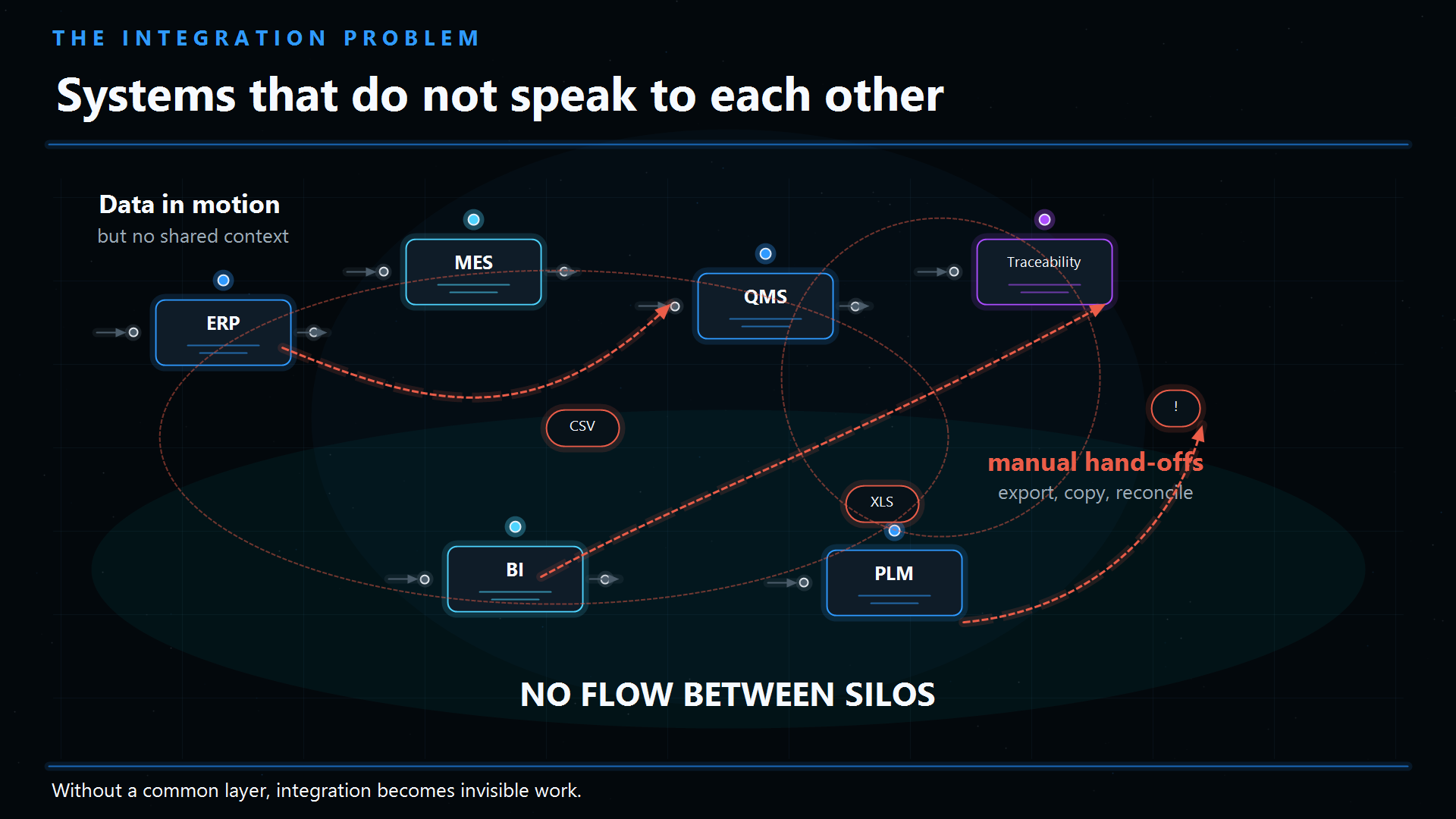
Middleware isn't a category of software you buy off the shelf. It's not even particularly glamorous. It's the operational infrastructure that sits between the systems organisations already depend on—connecting them, translating between them, moving data reliably from one place to another.
Good middleware is invisible. When it works, nobody notices it's there. Data moves from the shop floor to the ERP system automatically. Quality records synchronise with traceability platforms in real time. Alarms from control systems trigger notifications across teams without manual intervention. The organisation operates as a connected whole rather than as a collection of isolated islands.
Poor or absent middleware creates friction. It forces people to become conduits for information—manually transferring data, reconciling inconsistencies, creating workarounds. As organisations grow, this friction compounds. What started as a minor inconvenience gradually becomes a structural limitation that constrain show effectively the organisation can operate.
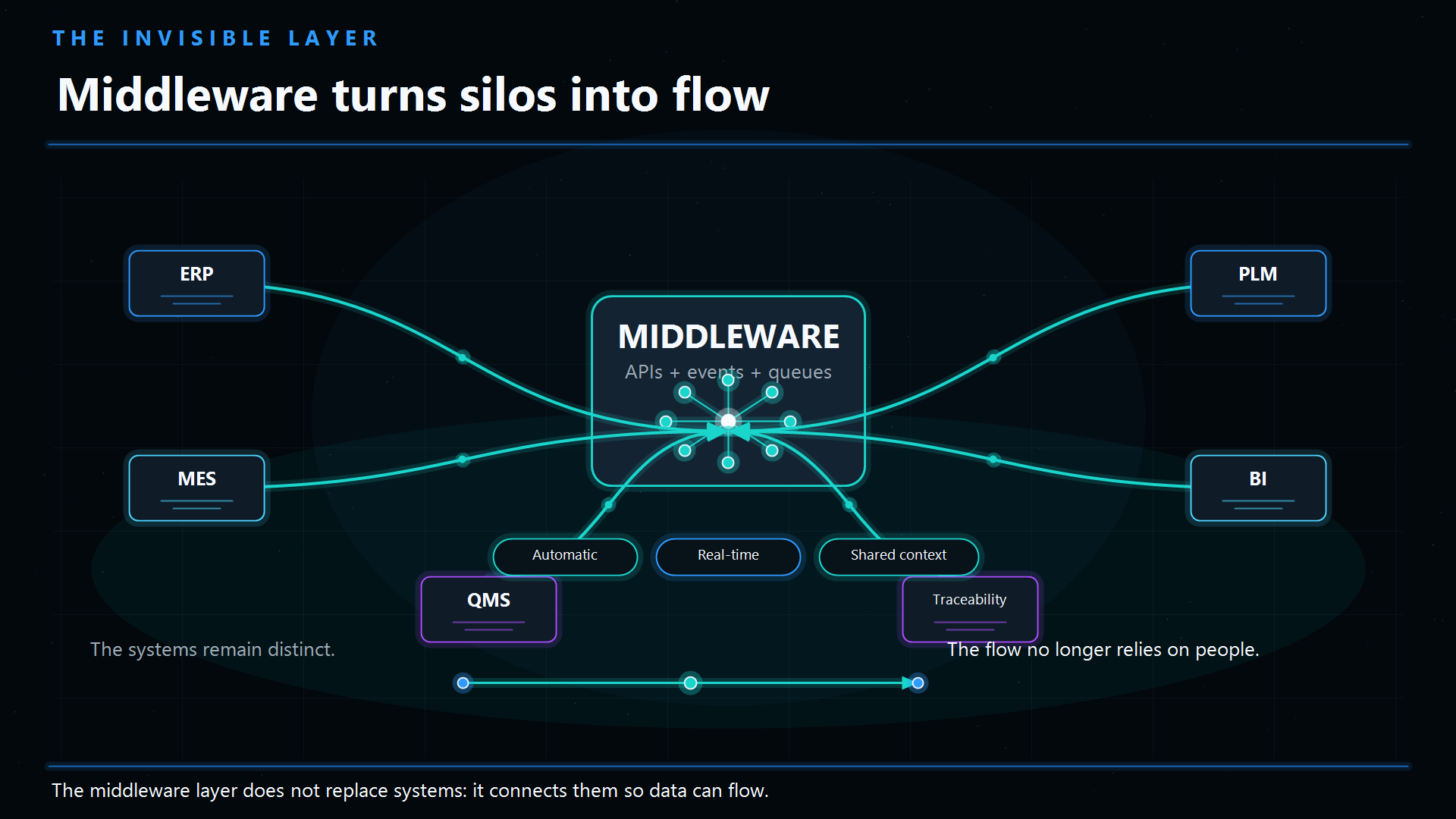
The middleware problem is hard to see because it doesn't announce itself. It doesn't generate headlines. It doesn't cause catastrophic failures; instead, it causes a gradual erosion of operational efficiency.
An organisation might invest in an advanced manufacturing system and see immediate returns. That system works brilliantly—for what it was designed to do. But now that manufacturing data needs to feed into quality systems, traceability platforms, and business intelligence tools. Connecting it correctly requires infrastructure that's rarely considered during the initial procurement decision.
By the time organisations recognise the problem, they've often already accumulated systems that are difficult and expensive to retrofit. The original purchasing decisions were made independently, without considering how future integrations would happen. Building effective middleware into an environment like that becomes a major undertaking.
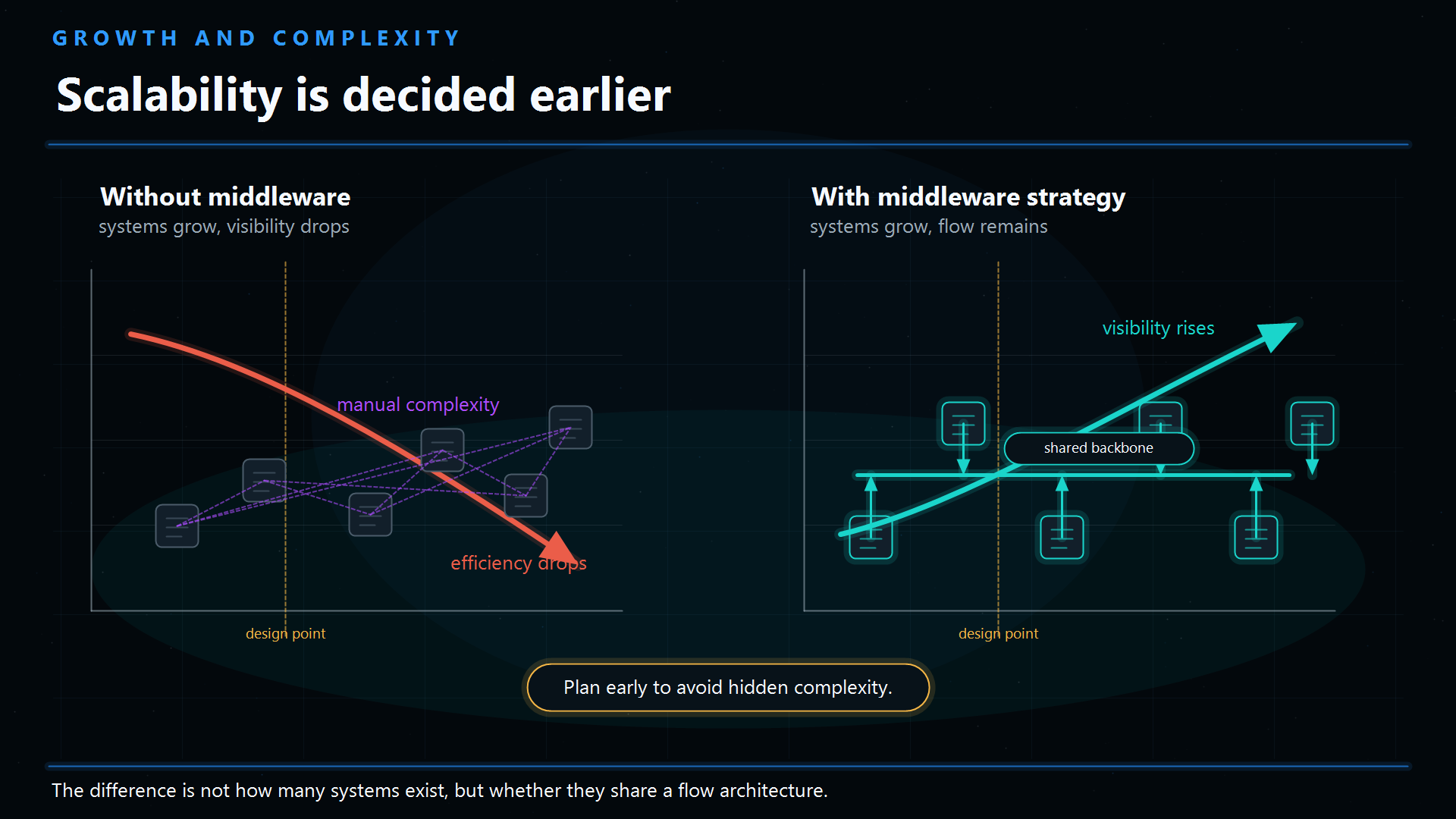
The organisations succeeding at scale are not necessarily those with the most advanced technology. They're the ones that made deliberate choices about system integration early enough that it didn't become an afterthought.
This means thinking about middleware not as a project you undertake when systems stop communicating, but as an architectural principle that shapes how systems are selected and implemented from the start.
It means recognising that in an increasingly automated environment, the value delivered by the control systems themselves is limited if they can't share information with the rest of the organisation. A system that optimises local performance while contributing to global chaos is a liability, not an asset.
It means building with the assumption that future integrations will be necessary, and that the infrastructure supporting those integrations should be designed with the same care as the systems being integrated.
This is the landscape we've been navigating since we started working with innovative organisations in technology and advanced engineering. Middleware is where we've built our expertise—not because it's the most visible part of a system, but because it's often the part that determines whether an organisation can actually execute its broader strategy.
We've seen what happens when organisations treat integration as an afterthought, and we've seen what becomes possible when they don't. We've built CoreTegral, a process management platform that uses configurable templates and interconnected components to bridge how systems communicate and work together. It's the infrastructure that solves the middleware problem—enabling organisations to orchestrate their operations without requiring every system to change.
This is the conversation we're bringing to TechWorks this year—not about the newest technology or the most sophisticated system, but about how organisations can build infrastructure that actually allows them to use the technology they've invested in effectively.
Because when middleware works, everything else gets better. Decision-making becomes faster. Operations become more visible. Organisations can grow without losing control. And innovation becomes something that can happen repeatedly, rather than something that's followed by years of operational complexity.
If you're attending the TechWorks Semiconductor to Systems Summit, we'd be keen to discuss how your organisation is thinking about integration and operational connectivity. These conversations rarely happen, but they should. Let's talk about the infrastructure that makes innovation sustainable.


Copyright © 2024 Savantech Limited


